
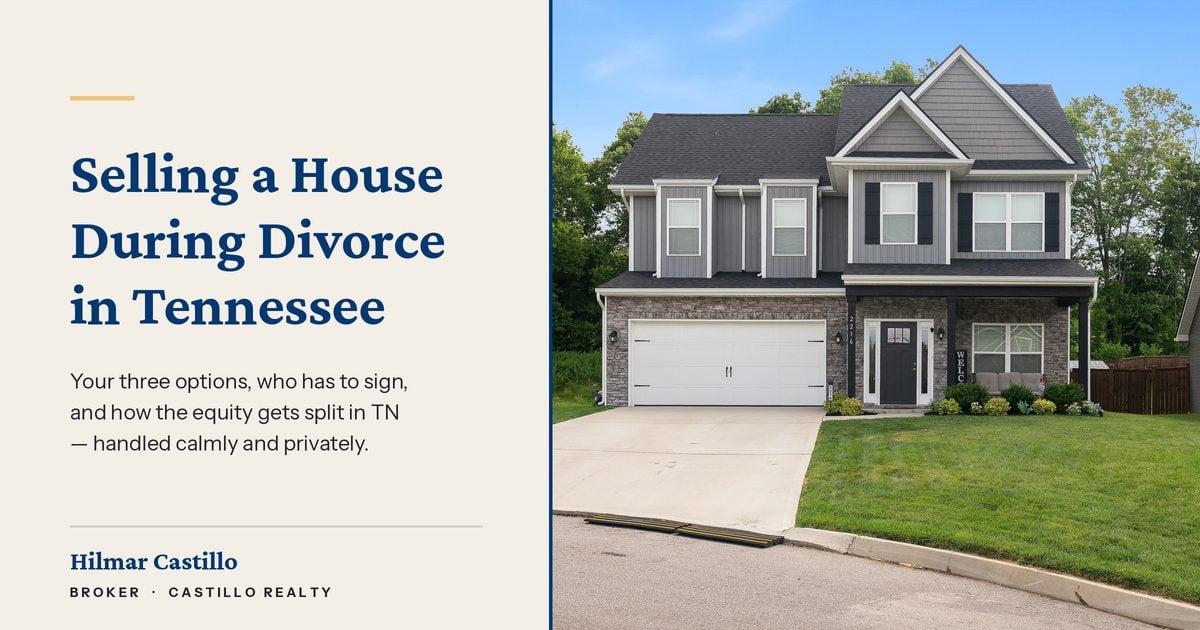
How does selling the house work in a Tennessee divorce, and can my spouse and I sell before it’s final?
Yes, you can sell before the divorce is final — but once the case is filed, neither spouse can sell the house alone. Tennessee law requires both spouses’ written agreement or a court order, and the net proceeds are divided under equitable distribution, not an automatic 50/50 split.
The house is usually the largest thing two people own together, and in a divorce it becomes the hardest thing to talk about. I’ve sat at kitchen tables in Farragut, Bearden, and Powell where the two people across from me weren’t speaking to each other directly — only to me. That’s a normal way for this to go, and it’s workable.
What trips people up is the assumption that whoever’s name is on the deed, or whoever is still living in the home, controls the sale. In Tennessee that’s not how it works. There are legal guardrails that kick in the moment a divorce is filed, and knowing them ahead of time saves you weeks and a fair amount of money.
Here’s what actually governs a divorce sale in Knox County and across East Tennessee, and the three realistic paths forward.
Selling a House During Divorce: Tennessee Divides Property Equitably, Not Equally
Tennessee is an equitable distribution state. Under T.C.A. § 36-4-121, a court divides marital property in proportions it deems just — which means fair, not automatically half and half.
In practice, plenty of Knoxville divorces do land near an even split. But the statute gives a judge room to weigh things like each spouse’s earning capacity, what each contributed, and each person’s financial situation going forward. A 60/40 division of the home’s equity is entirely possible.
This matters for one practical reason: you cannot budget your next move around half the equity until the split is actually agreed to or ordered. Get the number settled, then plan.
Once the Case Is Filed, Neither of You Can Sell Alone
This is the rule most sellers don’t know about, and it’s the one that stops deals cold.
When a divorce or legal separation petition is filed and served in Tennessee, a temporary injunction goes into effect automatically against both parties. Under T.C.A. § 36-4-106(d), both spouses are restrained from transferring, borrowing against, or disposing of any marital property without the other party’s consent or a court order.
Your house is marital property. So listing it, accepting an offer, and closing all require either your spouse’s written agreement or an order from the court. One spouse cannot quietly move it forward while the other is unaware.
That injunction stays in place until the final decree is entered, the petition is dismissed, or the parties reach an agreement. If you and your spouse both want the house sold, this is usually a paperwork step rather than an obstacle — your attorneys document the agreement and the sale proceeds normally.
Your Three Options for the House
1. Sell and split the net proceeds
The cleanest path when neither spouse can carry the mortgage alone or wants to. The home is listed, sold on the open market, and the net proceeds are divided according to your marital dissolution agreement or the court’s order.
The advantage is finality — no continuing financial entanglement, no shared debt, no arguments about who fixes the water heater. The trade-off is that both of you are moving, and both of you have to cooperate through showings, inspection negotiations, and a closing date.
2. One spouse buys the other out
If one of you wants to stay, that spouse buys out the other’s share of the equity. This typically requires an appraisal to establish value and a refinance to both pay out the departing spouse and remove them from the mortgage.
The part people miss: a quitclaim deed takes a name off the title, but it does not take a name off the loan. Until the mortgage is refinanced into one name, both spouses remain liable to the lender, and a late payment hits both credit reports. Talk to a lender early about whether the staying spouse qualifies on their own income.
3. Defer the sale and co-own for a set period
Some Knoxville couples agree to keep the home for a defined stretch — often tied to a school year or a set number of months — then sell and divide the proceeds. The agreement should spell out who pays the mortgage, taxes, insurance, and repairs in the meantime, and how the eventual sale price and timing get decided.
This works when both parties are cooperative and the numbers support it. It struggles when they aren’t, because you’ve kept a shared financial obligation alive after the marriage ended.
Where the Money Actually Goes at Closing
A divorce sale closes the same way any other Knoxville sale does. From the sale price, the following come out first, in order:
- Payoff of the existing mortgage and any second lien or HELOC
- Real estate commissions
- Seller closing costs and any negotiated buyer concessions
- Prorated property taxes and any outstanding liens
What’s left is the net — and only that number gets divided. In many divorces the closing attorney or title company holds the proceeds in escrow until the decree or the parties’ written agreement directs how they’re released. That’s a protection for both sides, not a delay tactic.
If you want a realistic picture of that net figure before you list, ask for a seller net sheet. It’s a line-by-line estimate, and in a divorce it’s worth having both attorneys look at it.
One Tax Question Worth Asking Before You File
Timing can affect what you keep. Under IRS Topic No. 701, a single filer may exclude up to $250,000 of gain on the sale of a main home, while a married couple filing jointly may exclude up to $500,000 — subject to ownership and use tests.
For a couple with substantial appreciation, selling while still able to file jointly can shelter a larger share of the gain than selling afterward as two single filers. Whether that applies to you depends on your filing status for the year of sale, how long each of you owned and lived in the home, and your basis in the property.
I’m a broker, not a CPA or an attorney. This is exactly the kind of question to put in front of a tax professional and your divorce attorney before you decide on timing — it can be worth more than any negotiating point on the contract.
How a Divorce Sale Is Handled Differently
The mechanics of the sale are ordinary. The communication is not.
When I handle a divorce listing in the Knoxville metro, both spouses get the same information at the same time — every showing, every offer, every inspection request goes to both, in writing. Nobody hears something secondhand. Decisions that require both signatures get flagged before they become urgent, not after.
Discretion matters too. Neighbors, buyers, and other agents don’t need to know why the home is on the market, and I don’t tell them. The listing is about the house.
Castillo Realty is a boutique brokerage, which means you’re working with me directly rather than being routed through a team you’ve never met. In a situation that already has enough moving parts, that consistency is worth something. I work with clients in English and in Spanish.
Frequently Asked Questions
Can I sell the house before my Tennessee divorce is final?
Yes. Many Knoxville couples sell during the divorce rather than after. Because the automatic injunction under T.C.A. § 36-4-106(d) is in effect once the case is filed, the sale needs both spouses’ written agreement or a court order — your attorneys handle that documentation.
What if my spouse refuses to sell the house?
If one spouse won’t agree, the other can ask the court to order the sale. That takes time and legal fees, which is why most divorcing couples in East Tennessee reach a written agreement on the house instead. Your attorney can advise on what your court is likely to do.
Does Tennessee split the equity 50/50 in a divorce?
Not automatically. Tennessee is an equitable distribution state under T.C.A. § 36-4-121, so a court divides marital property in proportions it considers just. Many splits land close to even, but an unequal division is permitted when the circumstances support it.
Talk It Through Privately
If you’re weighing whether to sell, buy out, or wait, start with real numbers. I’ll put together a free home value review and a net sheet for your property, and walk both of you through what each option actually leaves you with — no pressure, no listing agreement required.
Call or text Hilmar Castillo, Realtor®/Broker at Castillo Realty, at (865) 437-9539, or visit castillorealtytn.com. Serving sellers across Knoxville, Farragut, Bearden, Powell, and the surrounding East Tennessee communities, in English and in Spanish.
This article is general information about the home-selling process in Tennessee, not legal or tax advice. Consult your divorce attorney and a tax professional about your specific situation.